The solution
Explainable triage, not a black box
TiPSY is a deterministic, auditable rule engine. Every alert can be traced to the vitals that caused it, which is what makes it clinically deployable today.
Pipeline
From raw signal to acknowledged alert
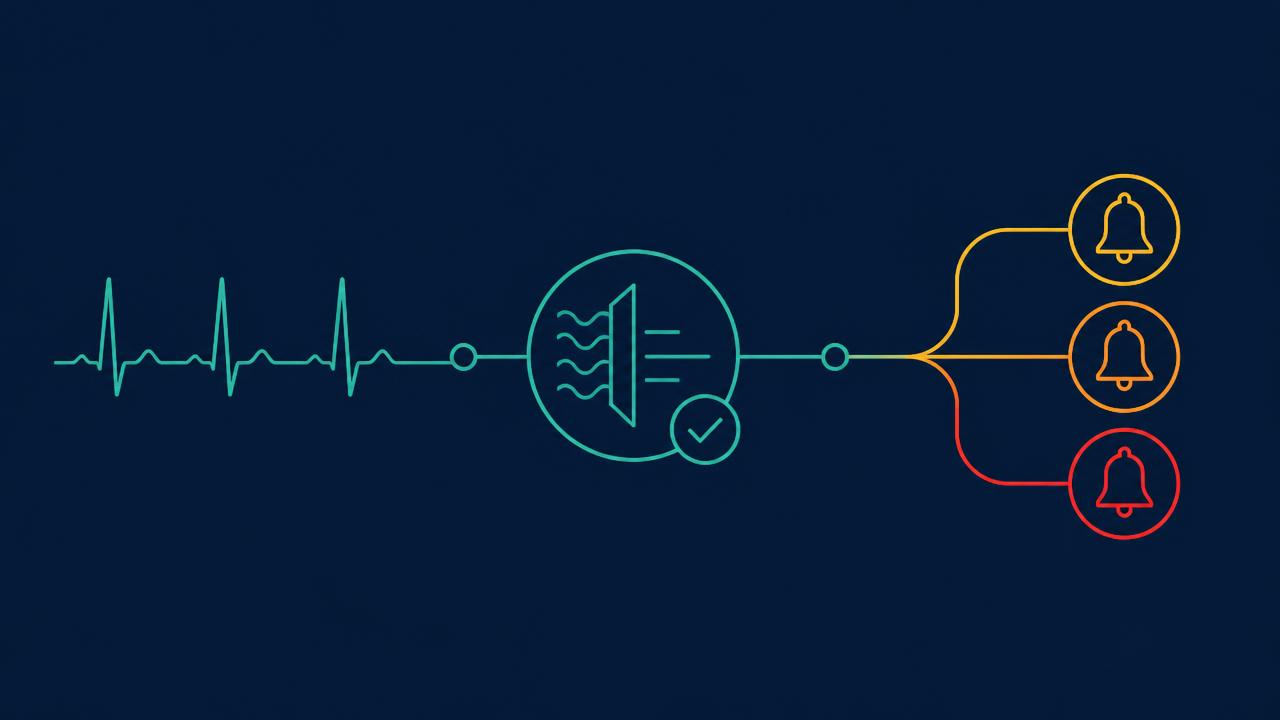
Acquire
Bedside monitors stream ECG, SpO₂, heart rate and blood pressure to the TiPSY gateway over the hospital IoT network.
Personalise
Each bed carries clinician-set limits for that patient's diagnosis, age and baseline — no overgeneralised defaults.
Corroborate
An abnormal ECG is held until SpO₂, HR and BP are assessed. If they are normal, the event is classified as artefact or lead contact loss.
Prioritise
The rule engine assigns Tier 1, 2 or 3 and shows the exact parameters that produced the decision.
Escalate
Unacknowledged alerts re-fire at rising urgency and route to the next responder until a clinician confirms.
Learn
Clinicians mark alerts as real or non-actionable; that feedback tunes thresholds and reduces future false alarms.
Priority model
Three tiers, one rule: noise never gets a siren
Only fatal events and alerts left unattended are promoted to high-pitched audible alarms.
Tier 1 — Yellow
Advisory
A single parameter drifts outside the patient's personalised range while others stay normal. Silent visual cue at the console; logged for trend review.
Tier 2 — Orange
Actionable
Two or more parameters agree, or a Tier 1 event persists. Visual pulse plus soft chime; nurse acknowledgement expected within the response window.
Tier 3 — Red
Life-threatening
Corroborated severe arrhythmia, desaturation or hypotension. High-pitched alert, bed highlighted, escalation timer starts immediately.
Worked example
Abnormal ECG on bed 4
The same waveform can be an emergency or an electrode problem. The difference is context.
Suppressed — artefact
- ECG · irregular, wide complexes
- SpO₂ · 98% (normal)
- HR · 82 bpm (normal)
- BP · 118/74 (normal)
No corroboration. Flagged as motion artefact / loose electrode, shown visually, no audible alarm.
Escalated — Tier 3
- ECG · irregular, wide complexes
- SpO₂ · 86% (falling)
- HR · 168 bpm
- BP · 72/44 (hypotensive)
Multiparameter agreement. High-pitched alert, bed flagged, escalation timer runs until a clinician acknowledges.
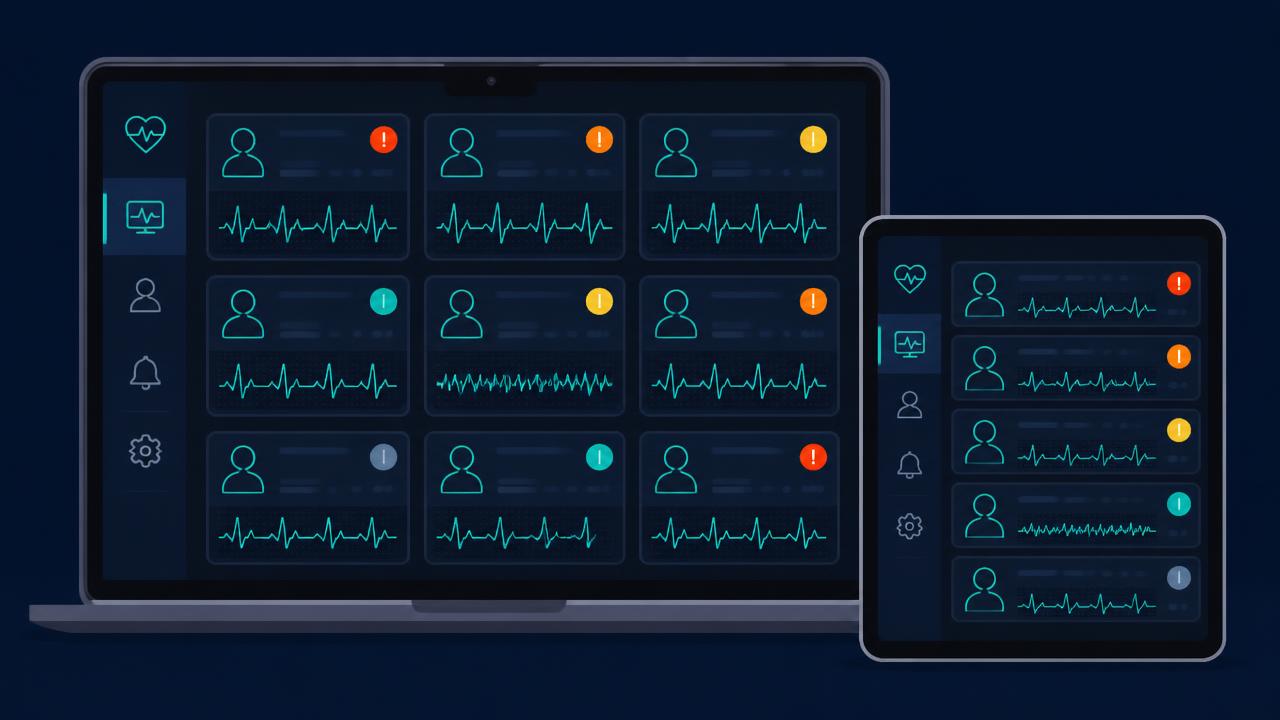
The console
One view of every bed, on any hospital device
Tiered badges, live waveforms and acknowledgement state — the same interface on a workstation, laptop or tablet.