About us
Team TiPSY
We are a MEDHA Hackathon 2026 team working at the intersection of critical care and engineering. We spent our time in and around ICUs listening to alarms nobody could act on — and decided the alarm itself needed rethinking.
Our story
Built from the bedside, not from a whiteboard
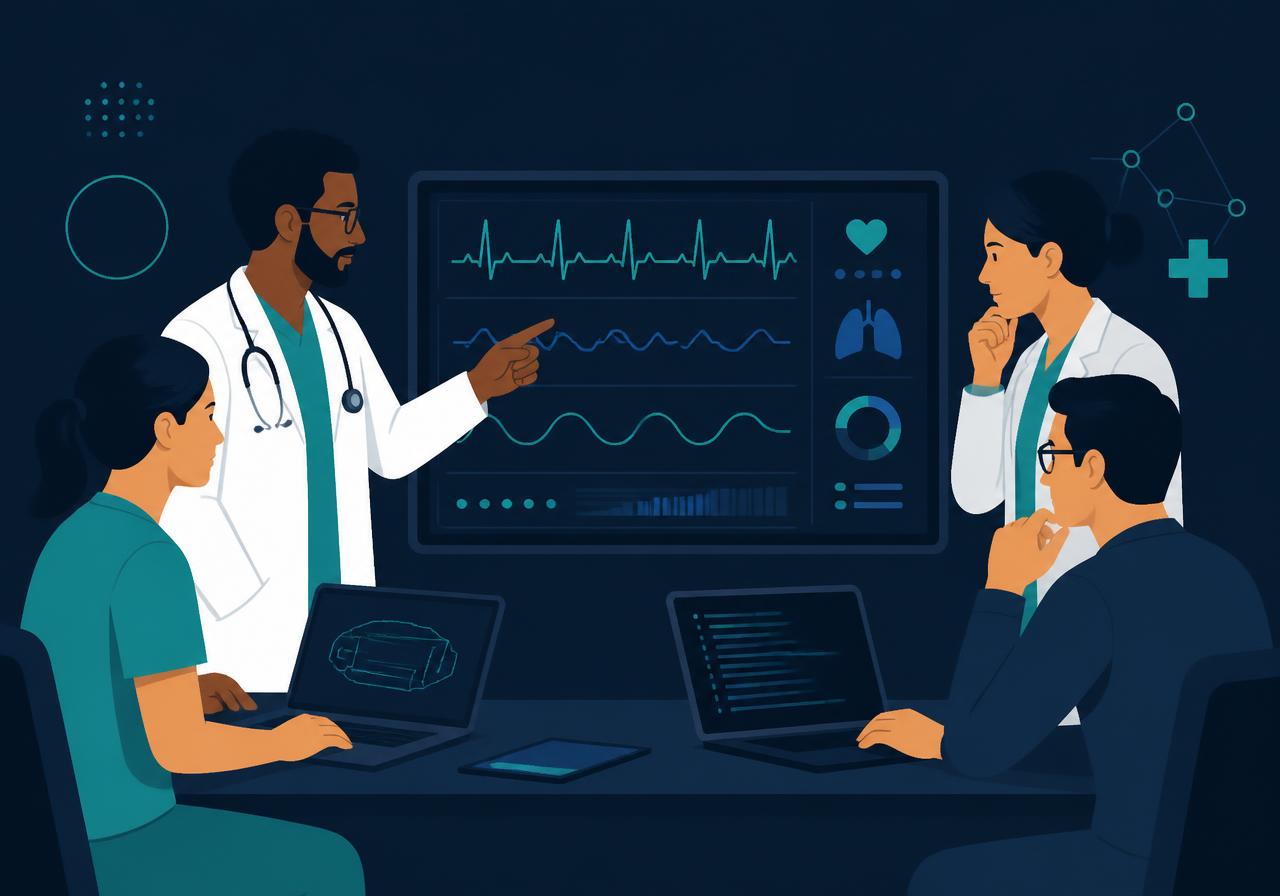
Our starting observation was simple: in a busy ICU with limited manpower, the alarm system is not short of information — it is short of judgement. Monitors alarm on every deviation, including electrode movement and turning a patient in bed, so staff learn to treat alarms as background noise.
We mapped where genuine deterioration hides inside that noise, then designed a triage layer that verifies each abnormality across several vitals before it is allowed to interrupt anyone. Because the rules are explicit rather than statistical, a clinician can look at any alert and see precisely why it fired.
The result is TiPSY: a personalised, multiparameter, escalating alarm system, delivered as a web console that connects to existing ICU hardware over IoT.
Clinical grounding
Thresholds and tiers reviewed against real ICU practice.
Engineering
IoT data ingestion, rule engine and a real-time web console.
Explainability
No black boxes — every decision is inspectable.
Feedback loop
Clinicians label alerts; the system keeps improving.
What we believe
An alarm should earn the right to interrupt care
Silence has clinical value. Every alert we suppress protects attention for the patient who actually needs it.
Personal over generic
A neonate, a cardiac patient and a COPD patient do not share one set of limits.
Corroborated over reactive
One abnormal channel is a hypothesis; several agreeing channels are an event.
Persistent over loud
Escalation until acknowledgement beats volume.
Next steps
Where TiPSY goes after the hackathon
Unit pilot
Deploy read-only alongside existing monitors in one ICU to benchmark suppressed vs. missed events.
Multi-ICU rollout
Extend personalised profiles to NICU, CICU and respiratory ICU on the same infrastructure.
Escalation routing
Integrate hospital paging and on-call rosters so escalation reaches the right responder.
Validation
Publish sensitivity and false-alarm reduction against clinician-adjudicated ground truth.
Want the short version? Watch the triage engine make these decisions in real time.
Open the simulation